
Dry Eyes / Meibomianitis / Blepharitis / Styes / Ocular Rosacea
The glands in the eyelids (meibomian glands) make the tears that lubricate our eyes. These are not the reflex tear glands that make our emotional tears, but the baseline tear production glands. The openings to these baseline glands frequently become plugged up. This same plugging up occurs in meibomianitis, acne rosacea, blepharitis, and styes.
These common conditions can be controlled by a simple technique that you can do at home. This technique is termed warm compresses (WC). But you have to do them every day for the rest of your life in order to control the symptoms. The directions on how to perform this technique will follow at the end of this section and on its own web page on the home page. A new in office treatment using a special eyeglass and heat is available. I’ve had good success with this, especially for patients that just won’t do the WC. The out-of-pocket cost is $125 for both eyes and the results last about 6-9 months. Yes, you still have to do the WC but hopefully not as frequently.

Meibomianitis (posterior blepharitis) is a very common condition and it increases as we get older. Most of my patients have this to some degree. Meibomianitis is an inflammatory plugging up of the meibomian gland openings that results in dry eyes, injected eyes, corneal infiltrates, or rarely, corneal ulcers. The corneal responses come from the toxins that the bacteria living inside the glands excrete.
Blepharitis (anterior blepharitis) is an inflammatory condition of the eyelash follicles and results in a dandruff-like material deposited at the base of the lashes. It can also give rise to red eyes, worsening dry eyes, corneal infiltrates or rarely corneal ulcers. It is also treated with warm compresses for life.
This is a photo of blepharitis or anterior lid disease. Treatment is WC every day for life.


This is a photo of meibomianitis or posterior lid disease. Treatment is WC every day for life.
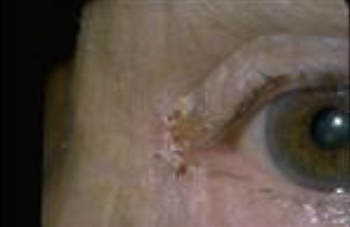
This is a photo of angular blepharitis, really the same process as the above two just at the outer eyelid area. Treatment is WC every day for life.
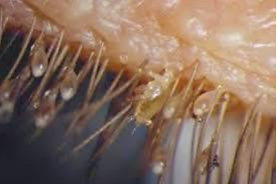
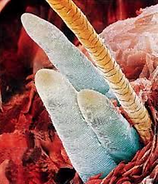
This is a photo of a demodex (small mite) infection of the eyelids. The mites are so small that they are difficult to diagnose without pulling some eyelashes out and using a microscope. The second photo is the mite itself. The third photo are of the mites living alongside an eyelash. The treatment is tree tea oil treatments.


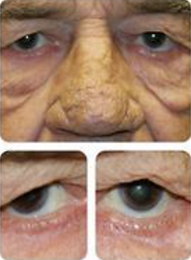
Here are two photos of ocular rosacea patients. Ocular rosacea is another chronic inflammatory disease that plugs up the meibomian glands. The treatment is WC for life.


This is a photo of meibomianitis that has a chronic staph infection of the glands as well, secreting toxins that irritate the cornea, causing ulcers in the cornea. You can see these ulcers as the small white dots just above lower colored part of the eye in the cornea with staining of these infiltrates in the second photo. The treatment here is WC every day for life with oral antibiotic for a short period of time only.
Do you see a trend in the treatments of the conditions above?
This web site has taken most of its information from the American Academy of Ophthalmology’s Preferred Practice Patterns publications. Each person’s medical condition is unique and all information should be reviewed with their ophthalmologist before deciding on any course of action. We cannot be held responsible for any use, misuse or outcomes from the information contained herein. Thank you.
SEDGEWICK EYE ASSOCIATES, P.C.
WARM COMPRESSES
(2-2-2 METHOD)
-
Warm a wash cloth or paper towel under hot water. Don’t burn yourself.
-
Place the warm washcloth or paper towel on your closed eyelids for about 2 seconds. The washcloth transfers its heat quickly.
-
Re-heat the washcloth and repeat the process 20 times. Do this 2 times a day. Heat up the lids as this is where most of the benefit comes from.
Significant cases of Meibomianitis and Blepharitis need to do this 2-3 times a day for 2-3 weeks to get the glands unplugged, and then twice a day for the rest of your life to keep them unplugged.
For styes, warm compresses need to be done 5 times a day until the stye is gone for a week and then twice a day for life. Topical or oral antibiotics aren’t going to replace warm compresses.
*Do warm compresses twice a day every day for life to control these conditions*